Back to the door Call 0577 174 2284
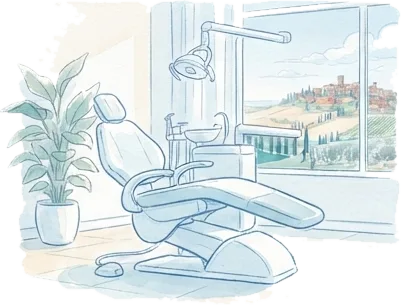
Watercolour illustration of the Val di Chiana, with the village of Torrita di Siena on the hill
Dental practice, Torrita di Siena

We're here for you.

We're a dental practice for adults and children in Torrita di Siena, Tuscany. Before any treatment we calmly explain what we see and what's needed, and we talk it through together, costs included.

Francesco Di Gioia speaks English: just say so when you call.

First, we explain

Before any treatment, calmly: what we see and what's needed. We make decisions together.

Written estimate

Item by item, before we start. If there's more than one option, you get them all, each with its cost.

Adults and children

One practice for the whole family. For the little ones there's also a world to play in, so they reach the chair without fear.

What we do

Who you'll meet

SI
Dr Simona
Children's orthodontics
How often for a hygiene visit?In depth, updated from what patients search for
FR
Dr Francesco Di Gioia
Clinical director
What we do bestChildren who are scared of the dentist
Replacing a toothIn depth, updated from what patients search for
GI
Giulio
Hygiene and prevention
Fear, as a grown-upIn depth, updated from what patients search for
GD
Dr Giuseppe Di Gioia
Dentist, founder of the practice
Bleeding gumsIn depth, updated from what patients search for
MA
Manuela
Dental assistant
Knowing costs upfrontIn depth, updated from what patients search for
EL
Elisabetta
Dental assistant
Teeth whiteningIn depth, updated from what patients search for
EM
Dr Emanuele Dieni
Oral surgery

The dentists' qualifications

Dr Maria Simona Marmo Children's orthodontics
Degree in Dentistry from the University of Siena (1997), licensed in 1998. Specialisation in Orthodontics, University of Siena (2003). Register of Dentists of Siena, no. 198.
Dr Francesco Di Gioia Clinical director
Degree in Dentistry from the University of Florence (2016), licensed in 2017. Register of Dentists of Siena, no. 419.
Dr Giuseppe Di Gioia Dentist, founder of the practice
Degree in Medicine and Surgery from the University of Florence (1987), licensed in 1988. Register of Dentists of Siena, no. 2.

Hours and contacts

Opening hours
Monday9:00–13:00 and 14:00–18:00
Tuesday9:00–19:00
Wednesday9:00–19:00
Thursday9:00–12:00 and 14:00–18:00
Friday9:00–13:00
SaturdayClosed
SundayClosed

The questions you ask us most

Short answers, with a diagram to see it at a glance. For your own case, we'll look at the rest together at your visit.
For you

How often for a hygiene visit?

How often should I have my teeth professionally cleaned?

For most people, every six months. People whose gums get inflamed easily, who wear a brace or who smoke usually need it more often. We’ll set the right interval for you once we’ve seen you.

A hygiene visit removes tartar, which is plaque that has hardened. Once it forms, a toothbrush can no longer remove it, which is why brushing well at home isn’t enough. At our practice the hygiene visit is done by Giulio, our dental hygienist.

Three sections of the same tooth: clean, with soft plaque along the gum line, with hard tartar. Below: how often to have a hygiene visit.Clean toothPlaqueTartarif it staysif it stayssoft: your toothbrushremoves ithard: only ahygiene visit removes itEvery six months for most people · more often with gums that get inflamed, braces or smoking
Replacing a tooth

I've lost a tooth. What can be done?

There are three options: an implant, a bridge resting on the neighbouring teeth, or a removable denture. Which one suits you depends on the bone, on the teeth next to the gap and on what you expect, and it’s decided after a visit and, usually, an X-ray.

It’s best not to wait too long: when a tooth is missing, the ones next to it tend to lean into the empty space. Before we start, we show you every possible option, each with its cost, so you can choose knowing what’s involved.

The three ways to replace a tooth: an implant in the bone with a crown on top, a bridge resting on the two neighbouring teeth, a removable denture. Below: if you wait, the neighbouring teeth lean into the gap.comes outImplantBridgeRemovable denturea new rootin the bone, with a crown on topa crown restingon the two teeth next to itcomes outand goes back inIf you wait too longthe teeth next to the gaptend to lean into it
Fear, as a grown-up

I'm scared of the dentist, even as an adult. Can anything be done?

Yes. Fear of the dentist is learned, usually in childhood: after a bad experience, or from hearing about it at home. And what is learned can also be unlearned.

It’s hard to do alone. It happens in the chair, calmly, one step at a time: first we look together at what you feel, then you learn to release the tension in your muscles, then to tell normal sensations, like pressure or pushing, apart from the ones you should flag. When needed, conscious sedation is also available.

Four steps, one at a time, to unlearn fear: looking together at what you feel, releasing tension, telling normal sensations apart, and conscious sedation if needed.1234Together we lookat what you feelYou learn to relaxyour musclesYou tell apart pressureor pushing from whatshould be flaggedIf needed,conscious sedationIn the chair, calmly, one step at a time
Bleeding gums

My gums bleed when I brush. Is that normal?

No. Healthy gums don’t bleed: usually the gum is inflamed because plaque stays in that spot.

The first instinct is to brush the bleeding area less, and that’s exactly what makes it worse. Keep brushing gently, there too, and floss between your teeth. If it’s still bleeding after one or two weeks, book a check-up.

On the left a healthy gum hugging the tooth; on the right an inflamed gum, swollen and red, with plaque along the edge. Below, what to do: keep brushing gently, floss, and if it still bleeds after one or two weeks, book a check-up.Healthy gumInflamed gumhugs the tooth,does not bleedplaque staysalong the edgeswollen,bleedsKeep brushing,there too,gentlyFlossbetween your teethStill bleedingafter 1 or 2 weeks?Book a check-upWhat to do
Knowing costs upfront

How much will it cost? Can I know before we start?

Yes, always. After the visit we explain what we’ve seen and what’s needed, and before starting any treatment we give you a written estimate, item by item.

If there’s more than one option, you’ll find them all, each with its cost and timing. That way you can think it over calmly at home and call us back when you’ve decided.

The path before any treatment: the visit, an explanation of what we see and what's needed, a written estimate item by item with every possible option, and a calm decision at home.1234The visitWe explain whatwe see and what's neededWritten estimate,item by itemYou think it overat home and call uswhen you've decidedOption AOption Bcost · timingcost · timingif there ismore than one option,you get them all
Teeth whitening

Can I whiten my teeth myself, with baking soda or charcoal?

Better not. Kitchen baking soda is a rough powder: it removes stains by scratching, and it scratches away some enamel along with them, for good. For charcoal, there aren’t enough studies to say whether it works or what it does to gums and saliva.

Whitening products bought on your own carry a risk too: a crown or a filling doesn’t change colour, the tooth next to it does, and in the end the difference shows. Teeth getting a little more yellow over the years is normal. First we look at your mouth, then we choose how to lighten it.

Left: the layers of a tooth; baking soda removes stains by scratching and takes some enamel with it, which does not grow back. Right: after DIY whitening the natural tooth gets lighter, the crown or filling does not, and the difference shows.enameldentinepulpBaking soda:removes stainsby scratching, andsome enamel with them.Enamel does not grow back.DIY whiteningbeforeaftertoothcrowntoothcrownthe natural tooth andthe crown: same colourthe tooth gets lighter,the crown does notCrowns and fillings do notchange colour: in the endthe difference shows
Electric or manual?

Is an electric toothbrush better than a manual one?

Used properly, they clean just as well: no study has shown that one is better than the other. Technique is what matters, and the time stays the same, about two minutes.

An electric toothbrush helps people who wear a brace, people who find it hard to move their hand and older people, partly thanks to the timer. Used with too much force it can hurt gums and teeth. Bristles wear out on both: change them when they start to splay.

Manual and electric toothbrushes clean just as well when used properly: about two minutes. Change the head when the bristles start to splay. Electric helps people with braces, people who find it hard to move their hand, and older people.ManualElectric=used properly,they cleanjust as wellabout 2 minutesnewsplayedchange them whenthey start to splayElectric helpspeople with braces, people who find it hardto move their hand, older people
During pregnancy

I'm pregnant. Can I go to the dentist?

Yes, and it’s a good idea: during pregnancy gums get inflamed and bleed more easily. Let us know when you book.

Hygiene visits and check-ups can be done throughout pregnancy. Treatment that can wait is usually done in the second trimester, the most comfortable time. X-rays are only taken when truly needed, with protection.

The nine months of pregnancy in three trimesters: hygiene visits and check-ups are fine throughout; treatment that can wait is usually done in the second trimester, the most comfortable time.1st trimester2nd trimester3rd trimestertreatment that can wait usually goes here:it's the most comfortable timehygiene visits and check-ups: throughout pregnancyGums get inflamed more easily:let us know when you book.X-rays only when trulyneeded, with protection.

For your children

When is the first visit?

At what age should my child have their first visit?

The first visit comes early, around the first teeth or in any case by age three: it’s for getting to know each other without any rush and for prevention, not for hurried treatment.

An age line from zero to six years: the first visit comes early, around the first teeth and in any case by age three.0123456yearsthe first visitfirst teethby age 3Early: to get to know each other and to prevent
Should a baby tooth be treated?

Do baby teeth really need treatment?

Yes. They matter for chewing, speaking and keeping space for the adult teeth. A neglected cavity in a baby tooth can hurt and complicate everything else.

Section of a baby tooth with the adult tooth growing underneath in the bone: the baby tooth keeps its place. It is also for chewing and speaking.baby toothadult tooth,growing underneaththe baby tooth keeps its placeWhat a baby tooth is for:chewing · speaking · saving space
The child who is scared

My child is scared. How do you handle it?

With calm and time. The first visit is almost always just about making friends. That’s why we built a world to play in: trust comes before the chair.

Three steps: first play in the valley, then the first visit is for making friends, and the chair comes once there is trust.123Play firstin the valleyFirst visit:making friendsThe chair, oncethere's trustTrust comes before the chair
The children's worldGames, cartoons, the toothbrush timer and pictures to print: so that the first time at the practice there's already a friendly face.Enter the valley →
Italiano